

Why Fly By Jing won't make cheap chili crisp
Founder Jing Gao on preserving her product's integrity, even at Walmart scale
When Kristen Bell wore a Fly By Jing sweatshirt in Nobody Wants This, the brand sold out, restocked, and sold out again—then watched bootleg versions show up online. For a chili crisp that started as a 2018 Kickstarter, that’s a long way from the beginning.
Gao was early to a simple idea: that a cultural staple could be bottled with premium, thoughtful ingredients and command a higher price point. Walk down grocery condiment aisles today, filled with all manner of beautifully packaged condiments made with intention and care, and you’ll see Gao was right—and that Fly By Jing’s sauces, crisps, and noodles are probably on the shelf.
Today, the challenge has changed: how do you take that cult-favorite status and scale it into a brand that turns up on Netflix and on shelves at Walmart? Gao discusses that, early business mishaps, and how that sweatshirt landed on Nobody Wants This in the first place, in the latest episode of Shopify Masters. The following is an excerpt of their conversation; tune in to the full episode below. —Leah Mennies, In Stock
The founder: Jing Gao
The business: Fly By Jing
Fun fact: Fly By Jing is named after the “fly restaurants” of Gao’s native Chengdu—hole-in-the-wall spots so good, the saying goes, they draw people like flies.
Serena: I love the show Nobody Wants This, and in it, Kristen Bell is wearing a Fly By Jing sweatshirt. How did that come to be? Did you reach out to them, or did they reach out to you?
Jing: It was completely unexpected. One of the cast members actually is a friend of mine and of the brand’s. Her name is Sherry Cola. And she was one day just wearing our sweatshirt on set, when they weren’t filming. And then Kristen Bell was like, “Oh my God, I love Fly By Jing, and I love that sweatshirt. I need it for the show.” And so that was how it ended up in the show. And we had no idea that it would be featured so prominently, and also was in the trailer.
Serena: Were you able to see if that actually had any kind of impact on the business? On product sales, on merch sales?
Jing: We normally just sell a few dozen a month on our website, and then it completely sold out. We restocked. It sold out again, I think twice. And then we started seeing these bootleg sites popping up that were selling our sweatshirts because we were sold out. And some of our customers actually bought them and sent us photos being like, “What is this?” ‘Cause apparently it had typos all over it. So when we started seeing that, we were like, “Oh, wow. You know you made it when you get bootlegged.” We turned on print on demand at that point.
Serena: You were building in public before people were even using that terminology—sharing the warts-and-all stories, not keeping too much of a shield between you and your customers. Was there any particular mishap that really seared itself onto your soul?
Jing: I would say the very first one really taught me a lot. This was the first shipment that came in from [our] Kickstarter. I had just moved to LA. I actually didn’t know anybody here, but I thought, ‘cause LA is closer to Asia, it might be a good base to get started. So I moved into an Airbnb in LA, and found a 3PL, which is a logistics company, to do the shipping for me. And I’d told them, “I’ve got these glass jars that are coming in from China. You’re gonna have to really protect them, because it’s very fragile.” And they’re like, “Yeah, yeah, we do this all day. We know how to do this.”
And three days later, I got the first email from a backer who was like, “What is this?” And it was a photo of a manila envelope with shattered glass and chili oil inside. So it was devastating, to say the least. At that point we had already spent it [our funds] on the production. I thought the business was over before it even started. So in a panic, I wrote an email to every single person: They may arrive broken. We will figure it out. We will reship you.
And people must have sensed the panic in my voice. They wrote back immediately. They were like, “Don’t worry about it, this stuff happens.” Somehow, by a miracle, only 15% of shipments were broken.
In that process, I was talking constantly to customers every single day. I realized the importance of transparency and the trust that you can build through a crisis. And that was something that we took with us moving forward, and how we approach customer service to this day.
Serena: You were DTC for years before retail, and you launched at a much higher price point than the other competitors in the Western market. I’d imagine it was an uphill battle to convince people of its worth. How did you convince consumers it was worth paying three or four times the price?
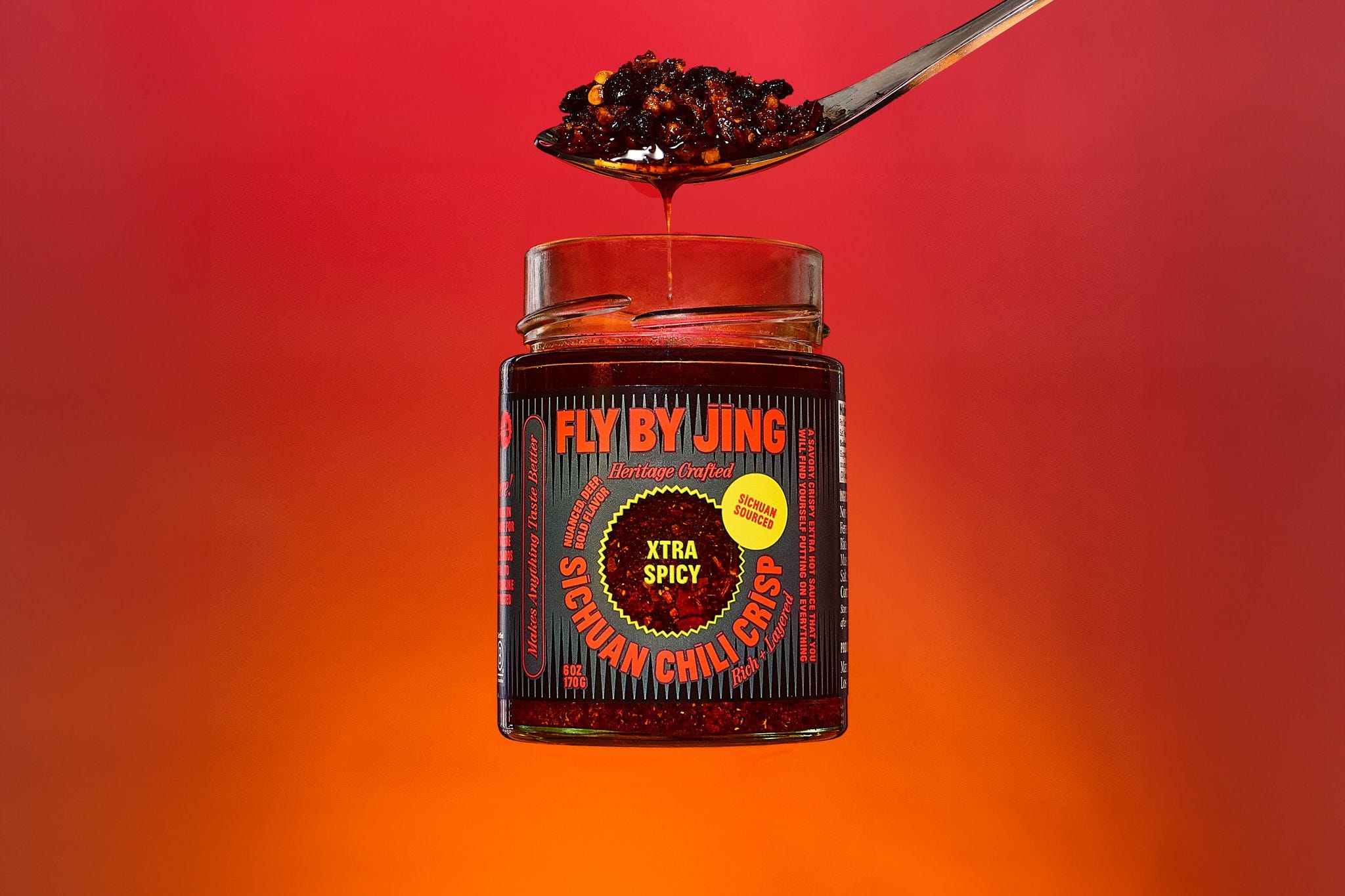
Jing: Mass-produced chili oil might have three, four ingredients in it, and one of them is artificial additives and flavors. Whereas my chili crisp—and we still have the same recipe as we did back then—has 18 ingredients in it. And the umami, the deep flavors in it are not through flavor shortcuts. We have ingredients in it that are fermented that you could not replicate without that time that it takes to go into it.
And also, this is a very small business. You can’t compare to the economies of scale of a billion-dollar conglomerate that has the advantage of scale. So when people shop small, it does come at a higher cost, because you’re supporting that.
People were so used to seeing Chinese food in that mass-produced format, where that low price point was out of necessity—because for the longest time, Chinese companies were told that Americans would not accept Chinese food that cost more than, like, $2. So of course, they’re not gonna put anything of quality in it. But I think this was introducing a new paradigm: that Chinese food, Chinese culture, Chinese people really have value that is worth paying for.
Serena: Hearing you say you were told American audiences wouldn’t accept Chinese food past a certain price point feels really loaded. It does feel like you’re saying something that’s not just about the food—something more deeply about the value of a cuisine, a culture, a group of people.
Jing: Yeah, absolutely. So at the time, there was a book that was published by a sociology professor, [Krishnendu Ray], at NYU called The Ethnic Restaurateur. And in it, he was discussing, why do certain cuisines cost so much less than others? And why do we go to a French restaurant and expect to pay top dollar, but then go to a Chinese or Thai restaurant and expect it to be cheap? His theory was that there’s this hierarchy that we place on cuisines. He calls it the hierarchy of taste. And that hierarchy is actually determined by the judgment of the socioeconomic status of immigrants who brought those cuisines to America.
And this is also a dynamic hierarchy. It changes. 100 years ago, Italian cuisine was also looked down upon and made fun of. And 100 years later today, you can go to a restaurant and pay $40 for a plate of pasta. So these things change, and they change with migratory patterns and socioeconomic status. And we’ve seen that happen over the last decade with the rise of Asian cultures and soft power in the US. And so I think that through brands like ours, like the others that have also launched since us, we’re part of that change and that evolution.
Serena: This is clearly much more than a condiment to you. You’re in 12,000 stores now, but your mission statement is to expand palates and minds. Eight years into this journey, how far do you feel like you’ve come, and how far do you have to go?
Jing: I was just at Expo West. We have a big booth at that show, and it’s been really amazing to look back and see that this is where it all started, where I just wandered the halls, didn’t know a single person, and didn’t see any Asian brands. And today, when you go there, it looks very different. It’s very diverse. There’s countless Asian brands—Chinese, Korean, Vietnamese, so many. A lot of those founders have come to us and told us that they were inspired to start their brands because of seeing Fly By Jing.
As difficult as it has been to forge a path when there wasn’t one before, it’s been so rewarding to see that there’s strength in numbers, and so many brands that have come in since—we’re all rising tides lifting all boats. And together, we’re really changing the way that America eats.
But at the same time, we’re just getting started. We just launched at 4,000 Walmarts a couple years ago, and that was the first time we really reached pretty much every corner of America.
We realized the majority of Americans still have no idea what we do, and no idea what to do with our products, and so there’s a lot of education. But we try to keep it fun, and the way that we’ve brought people into the culture has never been through preaching. How can this fit into how you’re already living and eating? That approachability is what has given us the growth.
This interview has been edited and condensed for clarity