

How Nik Bentel decides which absurd idea is worth building
Like, say, a brand-new bag made entirely of shipping straps.
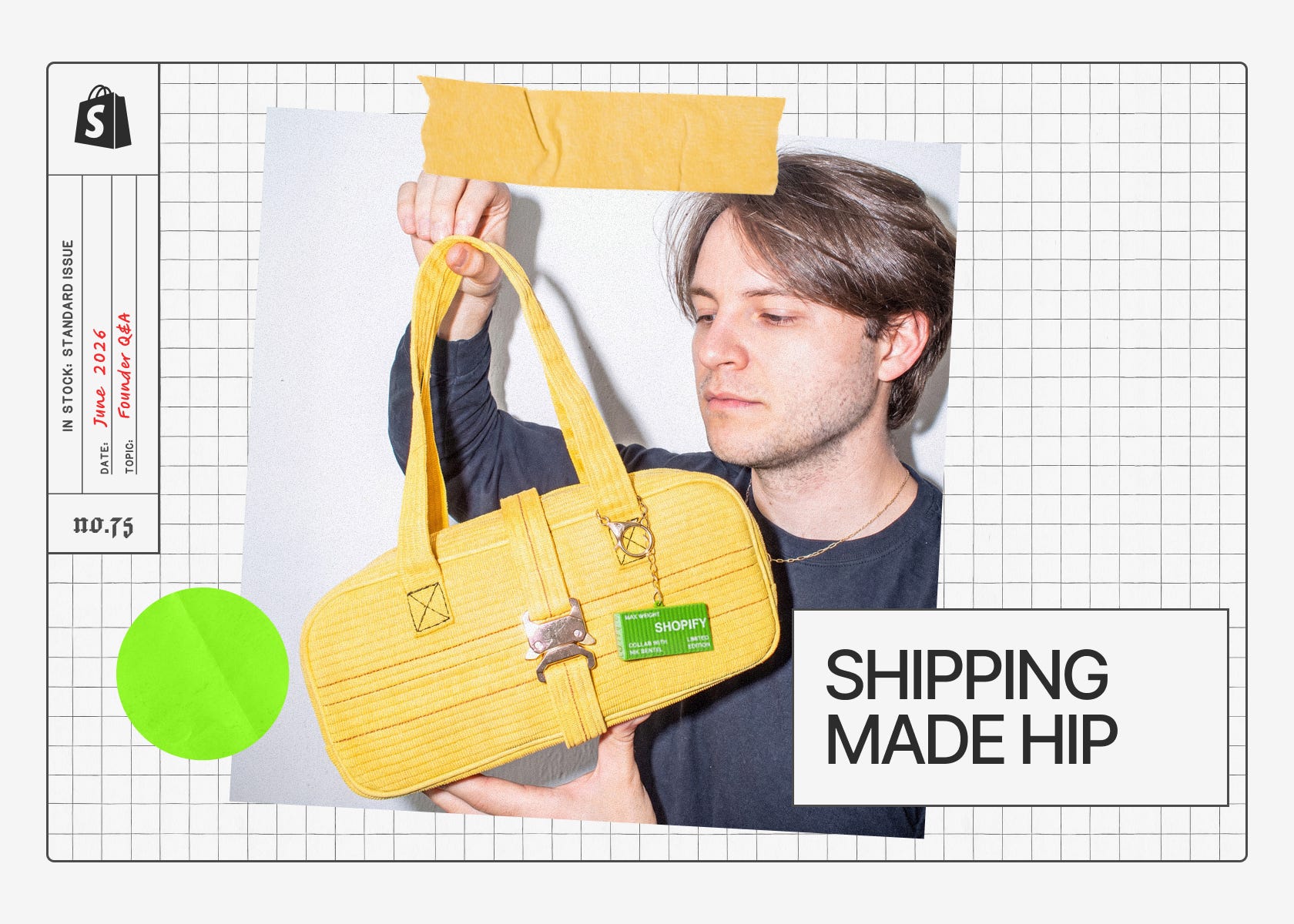
For years, Nik Bentel and his studio have turned everyday items like floppy disks, bottles of Tums, and extension cords into quirky, covetable objects. It’s a commentary on the mutable value of things we take for granted: “If you change the material, which might change the value of that object, people then will question what that object is, what that object could be,” he says.
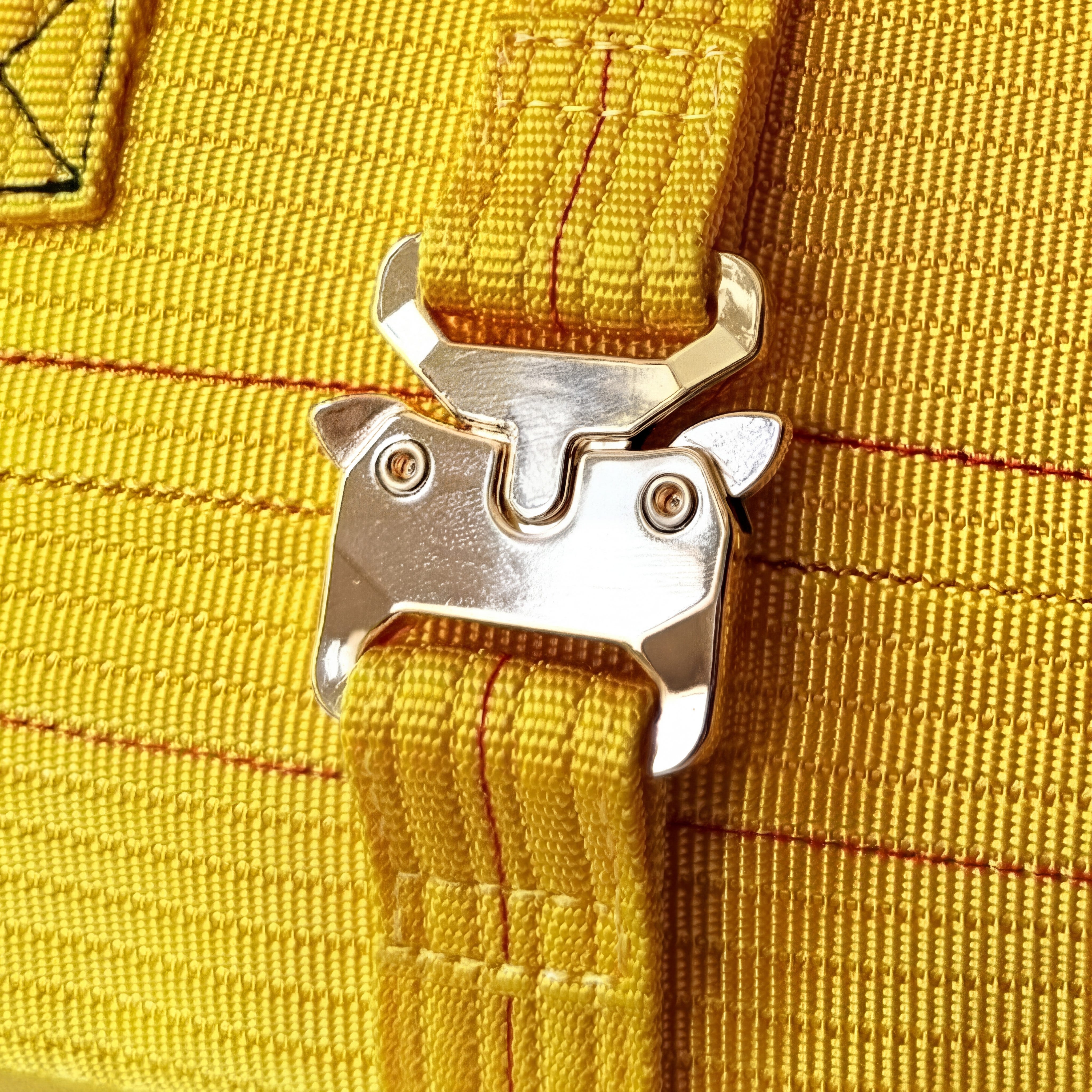
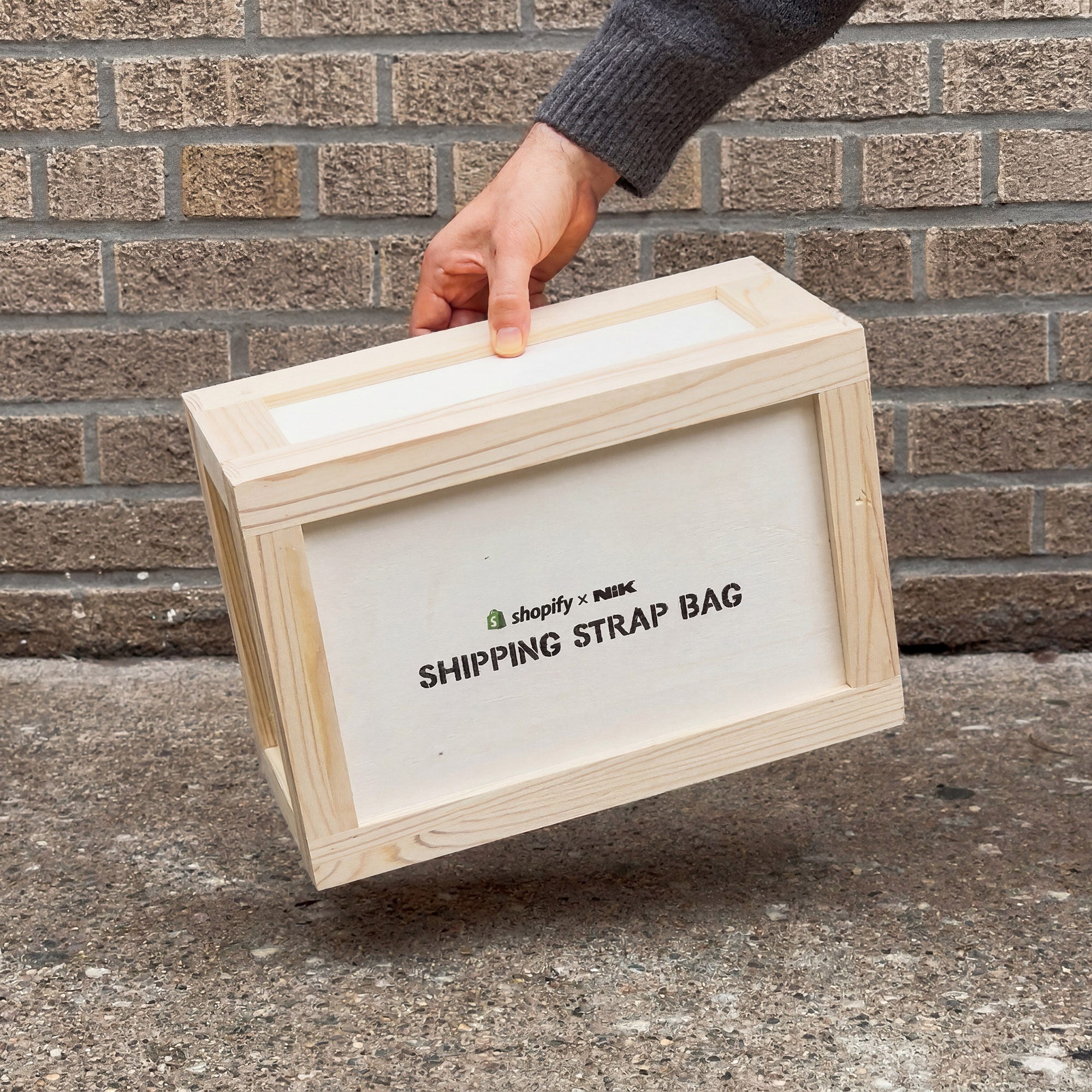
Bentel’s most recent collaboration, with Shopify Supply, turns that lens onto the everyday parts of commerce, territory the studio knows well from running its own fulfillment for monthly product drops. Called The Shipping Strap Bag, it’s a handbag made entirely of (you guessed it!) shipping straps, delivered in a wooden crate you open with a crowbar.
Like everything Nik Bentel Studio makes, the bag first had to clear a well-honed design process. “Ideas are plentiful,” he says on the studio’s website, “but bringing them to life is the real challenge.”
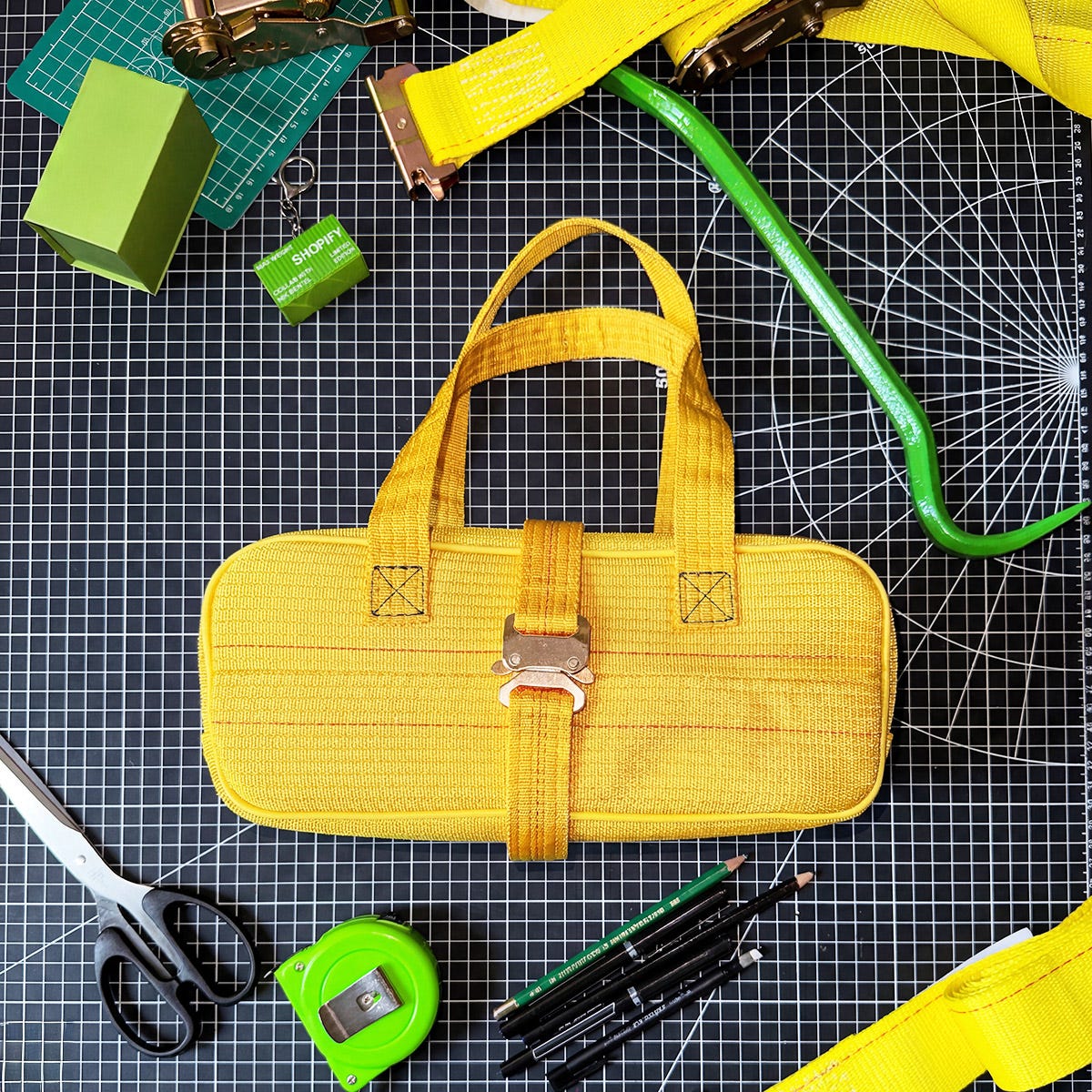
In the case of the handbag, the challenge was navigating the strap fabrication. The shiny look that reads “shipping strap” comes from the nylon in the weave, and “the more nylon, the more shiny it is, but with more nylon it’s harder to sew,” Bentel says. “So that was a balance of aesthetics versus can we actually make it?”
Ahead of the drop, Bentel hopped on a call with In Stock to walk through how he and his team decide which ideas are worth making, the design process this bag had to survive, and the shipping fails that his studio had to learn from the hard way. —Leah Mennies, In Stock
The founder: Nik Bentel
The business: Nik Bentel Studio
Fun fact: The studio’s RC Car Bag can actually move at 9 miles per hour.
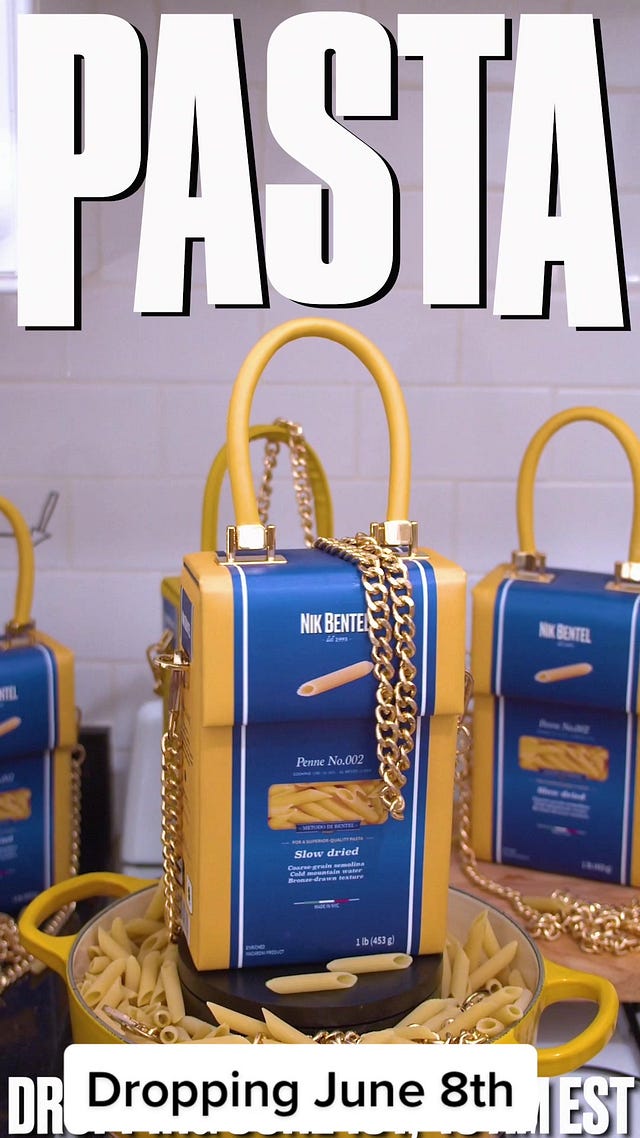
Leah: Your viral pasta box bag was an early foray into transforming an everyday object into a covetable item. Can you take me back to the spark? What was the original intention?
Nik: Objects have meaning, and changing the meaning of a thing very slightly really puts it in a new light. And that sounds so boring, but it’s so true. The handbags I was making during COVID resonated because everyone was stuck staring at their computers. You go to the grocery store, quickly grab a pasta box, come back, and you’re staring at this graphic design of the food you’re getting, and thinking of how mundane this thing was.
 Tiktok failed to load.
Enable 3rd party cookies or use another browser
So that was the moment where I was like, okay, can we elevate this thing a little bit that we’re all experiencing?
A handbag is a really great object because it’s a unique vehicle to have an idea. There’s not an exact price on a handbag. A handbag could be $0; people sell handbags for $100,000. You don’t need to put things in a handbag. We have a lot of handbags that we sell that hold nothing—they’re just performative objects. So the handbag has accidentally been a really great vehicle to share some of these value-manipulating ideas.
Leah: Part of that is the bag living in the world too. You hold it, it’s contextualized against what you’re wearing, it moves with you. Is that part of it?
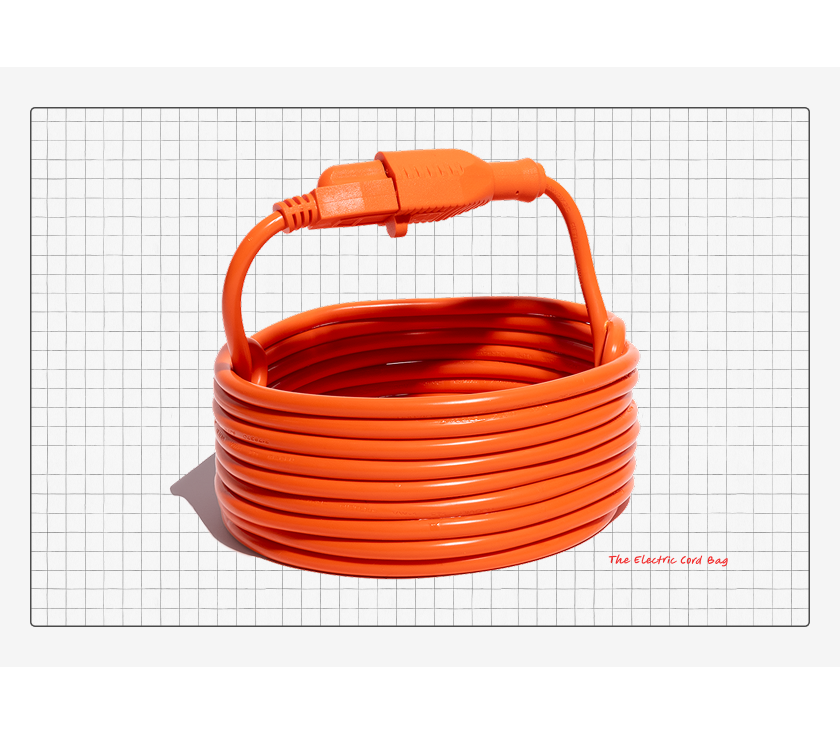
Nik: One of my favorite examples is we made a handbag out of an electric cord. The electric cord is 25 feet long; you can get them at Home Depot for $20. We glued it in a unique way to make it a handbag, and people were bringing them to fancy dinners.
That recontextualization was so exciting, because it was one move that we did, just gluing it in this unique way, and people found such excitement over this incredibly boring thing. Just seeing people go to gala events with these things, going on the runway with it, was so fun, because it really meant that the idea added significant value and excitement into people’s lives, from just something that you could find in your drawer.
Leah: I loved this line from your studio’s about-us film: “Ideas are plentiful, but bringing them to life is the real challenge.” In the video, you described the five-pronged filter you run ideas through: what’s the story, why this story, what’s the one move, can we make it, is it worth it. Can we walk through how the Shipping Strap Bag came to be using that framework? Let’s start with the story. What was the starting point?
Nik: The story was: how can we make an object that shows the collaboration of Nik Bentel Studio and Shopify? We have a lot of really amazing graphic identities and beliefs that, if you put us in a Venn diagram, we would share. So it was pulling that identity out, and making it fun, poppy, and unique. Then the next was: how can we make an object that celebrates the shopping experience, really celebrating how we sell things?
Leah: Why this story?
Nik: We at the studio sell things every single day; we have these monthly launches. So the why is really, why are we doing that ourselves? If we make something, we have to use Shopify to make the thing; it’s part of our monthly launch sequence. We could easily stop selling things, but having people be able to purchase the art objects and be part of the narrative, part of our world-build, is so exciting. It really elevates it to something way more exciting than a simple image online.
Leah: And the one move for this project?
Nik: Stitching the shipping strap material into a handbag form. That was the one move.
Leah: Then: Can we make it? Did the idea just work, or did it take iteration?
Nik: When we do a design with a client, we do what internally we call “The Project Gauntlet”: a variety of things we need to pass to make sure we can do it. We can make things, but sometimes they end up being $10,000, and no one’s going to buy that, so we try to find a middle ground. In the design process we had a number of concepts we really loved at the beginning that ended up getting removed via The Project Gauntlet because they were too complicated.
Sticking with the everyday materials we have at the studio just felt like the perfect route. We use shipping straps constantly. This is something we know. It’s colorful, very utility-driven, very much like the electric cord, where you don’t expect it to be in a fashion space.
Leah: And is it worth it? Also, how do you define “worth it”?
Nik: It’s a bit of: If we make these things, will they not sit on the shelves? Will people enjoy them? Will it take a reasonable amount of time, and not 10 million hours to make this thing? We want to make sure it’s an actual thing that we can achieve.
Leah: For a lot of entrepreneurs selling physical products, shipping is the last hurdle. You’ve done all the work to make the thing, and now it just has to make it to the customer. It can be an emotionally fraught part of the process. How do you think about shipping as a studio?
Nik: The one thing that is very specific to us is that we’ll ship a really tiny thing one month and then ship huge things the next month. The handbag has been one of these successful things where there’s a certain size—we’ve gotten it down.
There’s a bit of a learning curve to what we’re doing, because we might be shipping chairs at one point. A good example is the Loopy chair, a chair that we’ve designed and we sell. The first iteration was one inch too big on all sides, so we had to have it on a pallet. The next iteration, we did it the right size. But it was one of these things where we should have thought about how it shipped.
To your point, the shipping experience is very much part of the designing. We’ll think about the shipping and also the unboxing experience as we’re designing it, and as a designer that’s something you’re not told in school, and something you learn along the way.
Leah: Once you settled on the shipping straps, the bag ships in a wooden crate you open with a crowbar. Did the packaging come at the same time as the bag, or after you knew you wanted to use the straps?
Nik: The packaging comes in a wood box, and the wood box is very much an experiential wood box if anything. The handbag won’t get destroyed on shipping, but it’s so fun to mimic some of the shipping language that happens in the world, and just further amplify the story of shipping.
Thinking about the colors and graphical content that happens in the shipping journey is just really fun. That’s why it’s a little bit more of a narrative pusher than utility. And at the studio, we love that certain things just purposely don’t have total function unless they’re part of the narrative, and that’s great.
Leah: This is a founder-centered audience, so I’m curious about the business side. How do you make the decisions on pricing and quantity, the calls on the other side of all the creative ones?
Nik: We always want to make sure that we’re not doing a ton of units, for two reasons. One is we always want to try to sell out, and we also don’t want items sitting on a shelf and not being used, so we never want to overproduce. But to get the right unit amount and also the right price point is such a balance. We’re constantly checking ourselves. When we do a new project, we all guess which one is going to do the best. We have many projects booked throughout the year, and it always never is the one that you think it is.
Some of our wallets have done the best and helped support other projects that aren’t doing so well. So the biggest solution, if we’re launching these unique projects every month, is consistency. If a project does super-well and we end up getting thousands of orders, that supports the next project that might not do so well. If you sell 10 handbags, that will financially support us more than selling 10 wallets. So it’s a constant balance of what the object is, how we’re selling it, how many units. There’s never a right answer.
Leah: You do a lot of brand collaborations, and a collaboration always involves some degree of compromise. What are your creative non-negotiables, and how do you keep something recognizably a Nik Bentel product?
Nik: I really want the brand to speak first and then we react. We have a choose-your-own-narrative style of designing where we’ll share 10 concepts to a client. They get to choose one of those concepts. Then we’ll iterate on that concept and then show them three revisions of that concept. Then we’ll go into the design part of the process, where we will then design a few different versions of that.
So along the way, we’ll always propose things that we will feel brand alignment with, and have the brand react to those things. I love the choose-your-own-narrative thing, because whoever we’re working with is really in the driving seat, while we’re in the back figuring out all the details. We’re always comfortable sharing the things that we enjoy. I feel very lucky that brands will come to us and just be like, “We have no idea what we want.” And that’s totally fine. That’s perfect.
Check out Nik Bentel Studio’s new collaboration with Shopify Supply.
This interview has been lightly edited for length and clarity.