

Trinity Mouzon Wofford thinks you need a lunch break
The author of the new cookbook, Eating at Home, on running a business minus all of the busy-ness
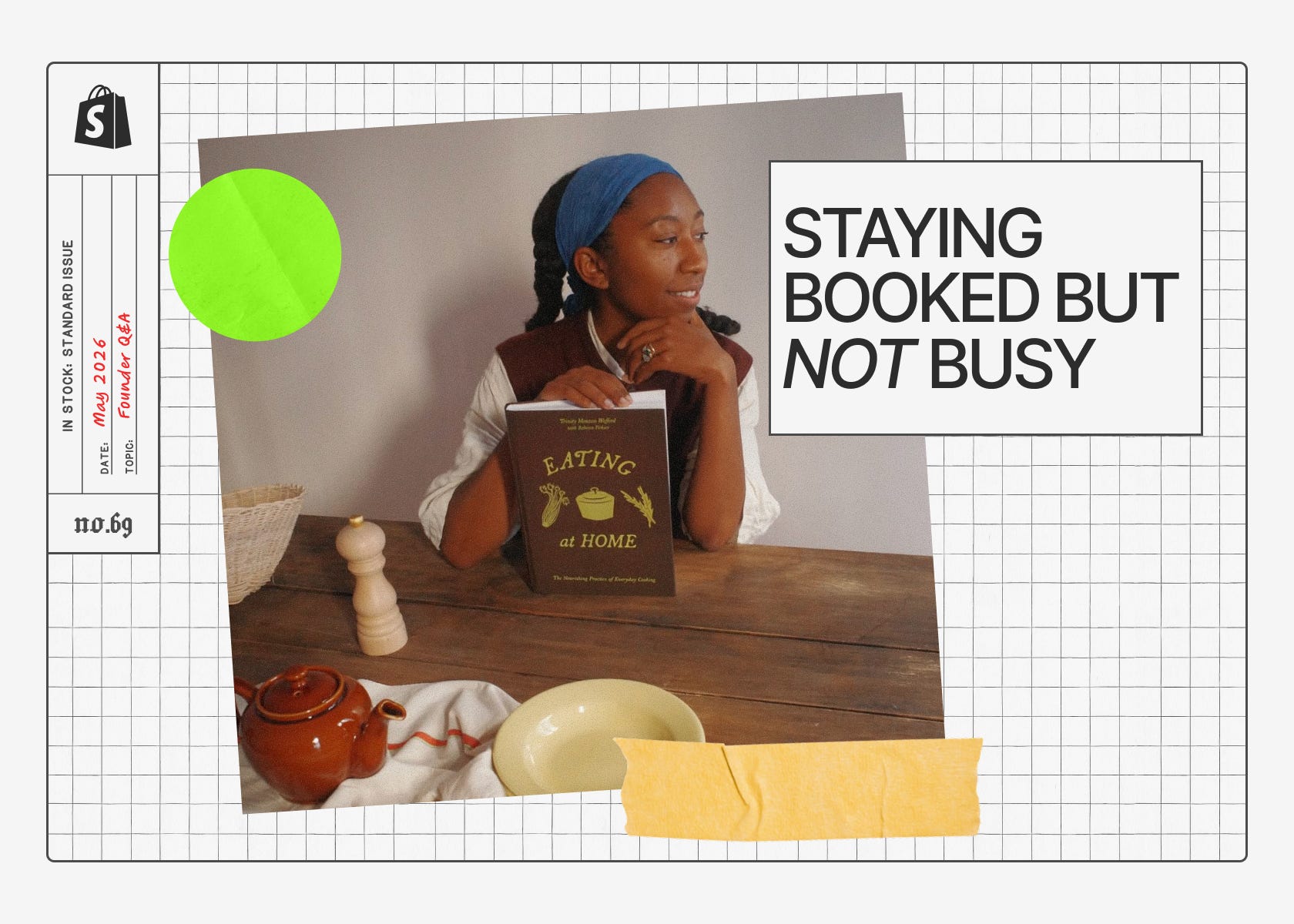
Trinity Mouzon Wofford and her husband, Issey Kobori, co-founded the wellness brand Golde from their Brooklyn apartment in 2017 with one goal: making $2,000 a month to cover their rent. Today, the couple run their business and raise their family in upstate New York, where cooking at home is an anchor. “I think food in our relationship has always been a way for us to come together,” she says.
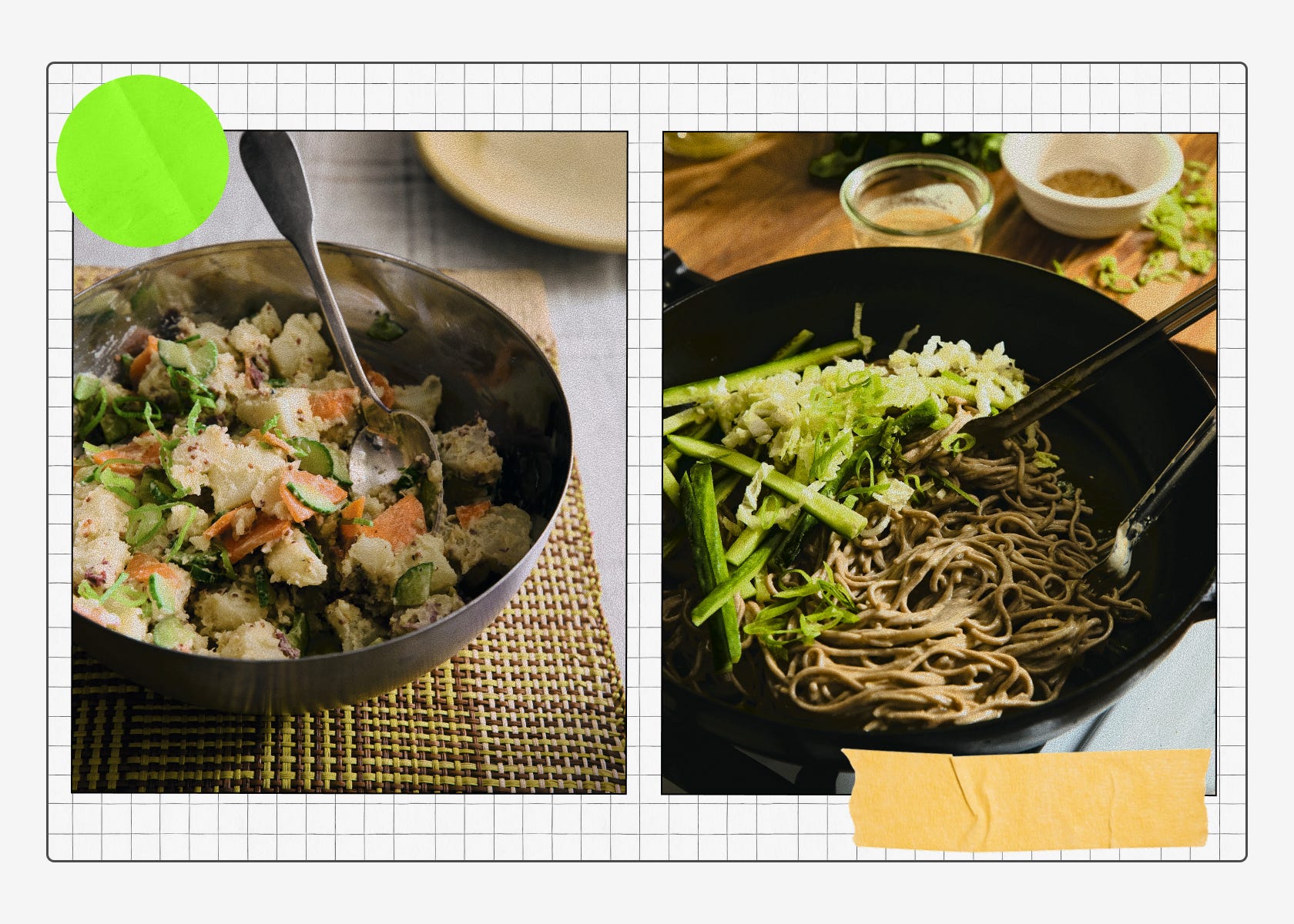
Last month, Mouzon Wofford released Eating at Home, a cookbook chronicling the recipes that she returns to, like dashi-scrambled eggs, sweet rosemary cornbread, and sesame soba noodles.
Mouzon Wofford decided to keep Golde—known for its superfood beverage blends—out of the book. “I was always very clear from the beginning that I didn’t want to write the Golde cookbook,” she says. “I wanted the book to be able to stand on its own two legs.”
Instead, Eating at Home is an argument for cooking for yourself, even when life, or work, gets in the way. “My entrepreneurial journey is what brought me to the way that I cook today,” she says.
She began working on the book while pregnant with her first child, and had her second before it was published. What got her through the process is the practice that forms the book’s thesis: Deliberately creating space to pause, often in the form of a sit-down lunch. She shares why it matters ahead. — Leah Mennies, In Stock
The founder: Trinity Mouzon Wofford
The business: Golde
Fun fact: Mouzon Wofford, and her husband and co-founder, Issey Kobori, are high school sweethearts.
Leah: Where did the idea for Eating at Home come from?
Trinity: The initial idea for the proposal was: What is eating well according to Trinity, founder of Golde? I started to list off farmers markets, and eating locally, and just even having a reverence for meal time itself. And the funny thing was that when I would put those ideas to paper, the immediate follow-up question that I would get from anyone who was reviewing it would say, okay, but everyone’s so busy. What can we do if we’re too busy for this?
That dialogue was what ended up forming the real thesis of the book, which is that yes, we are all so busy and also we need this. That was really the spirit that the book was born from.
Leah: You’ve described cooking as a counterweight to your entrepreneurial frenzy when starting Golde. What were those early days actually like?
Trinity: So, in the very early days there was time. I wasn’t in back-to-back Zoom calls. What started off as this little independent, creative turmeric latte mix company suddenly was on the cutting edge of wellness. We had this beautiful community of folks who were following us, interested in what we had to say about accessible wellness.
Then around the pandemic, we raised some venture dollars, we scaled the team, and we launched into big box retail. It was everything everywhere all at once. From the moment I woke up until 7 p.m., the calendar was booked out.
It was also a weird time because this was 2020. There was the whole movement to support Black-owned brands at that time, and we were sort of in the perfect storm there: We were independent but big enough that people knew to recommend us, and so we were flooded, and it was good for business.
But for me personally, it was very taxing, and it was very bizarre to be grappling with what humanity was going through in that moment and then simultaneously being put on the pedestal of, like, here is a model Black founder, go buy her things to fix the problems.
Making time for a lunch break does start all the way in those earliest days of Golde. I didn’t always feel like I was in control of things that were coming at me and my response to them—but I always had that grounding period of sitting down to eat. Once I started to have employees and people who were booking me for things on my calendar, it was written in stone that from 2 to 3 p.m. was lunch, and there were no calls at that time. I’ve kept it blocked on my calendar ever since.
Leah: You call sitting down for lunch a “radical idea.” How did you come to see lunch as radical, especially as a founder?
Trinity: I think that we are in a cultural moment where busy-ness is holy. It is the grounds of proving that you are making good use of your time, and it seeps into daily life for all of us.
I have found that rushing is, in my own life, a bad habit the same way that procrastination is. And not rushing requires a lot of rigor and discipline because it’s not in our nature, right now at least. There’s this sense of well, I’ll take lunch breaks maybe when I’m retired. One day when I’ve worked hard enough to earn the pause, I will take it.
But in my own life, I have found that it’s very easy to live every moment in a future state, where you’re constantly thinking about what you will do and what’s coming down. And it’s a practice to say, okay, can I be right here? Can I be present with this?
Leah: You write about resisting an outcome-centered approach to cooking. How do you translate that mentality to running a business, where outcomes are how you’re measuring success?
Trinity: I’ve definitely found that I am most satisfied in my identity as an entrepreneur and my daily life where I structure things in a way that I don’t have to rush.
There’s the anxious tendency to be looking at what others are doing or thinking about what others might be thinking about what you’re doing, and to get into this state of making decisions out of desperation. Those feelings are not real, right? The business in itself is something that you’ve made up, and I think it can be helpful to remember that it can also be playful, and that the perspective doesn’t have to be so heavy just because there are dollars involved.
It can be a joyful practice to get inventory from one warehouse to another in the right time frame, especially if you are approaching it every day with a sense of curiosity and ease and possibility. I think every entrepreneur has this tendency to feel like their business is a weight on their shoulders, right?
But I think it’s very similar to cooking, in that when we view it as a chore, it’s very hard and it’s very terrible, and we don’t make food that tastes good because we go to whatever the place that’s most convenient is to get our produce and it’s not good, and we just scramble it around in the pan and throw it on a plate, and we say, see, this is why we should have gotten takeout.
When I bring an attitude of possibility and play and curiosity to business, then I have a day that feels that way. And if I have the attitude of the sacrifice and the horrors and the drudgery, then that is the day I will have at work.
Leah: Your co-author Rebecca Firsker is someone you’ve described as teaching “this very insular person that there’s so much to benefit from good partnership.” What was the collaboration process actually like, for someone used to building a universe out of your own mind?
Trinity: My agent introduced us, and I knew I needed help, and she had worked her way through the whole world of food media. Testing recipes and developing recipes is extremely hard work—I found it to be the least pleasant process, and was so grateful to have Rebecca really taking the lead on that piece.
What was challenging for me was that these are literally the recipes that Issey and I cook at home. Even in Golde, Issey and I, there was always a layer of separation, between us and everyone else working at the company. I learned a lot working with Rebecca because I found that at the end of the day, there was a lot to be said for letting people in.
This really taught me how to also be a better leader in my business. I was afraid to let people in because I realized that I wasn’t very comfortable yet standing on my own opinion and saying, Yes, I hear you, but it’s going to be this way because I say that this is right, and I’m sure of it. I had the sense that as soon as I let somebody in, I would have to acquiesce to what they were looking for and that the project would not be what I had intended it to be.
It taught me a lot about how much goodness there is in collaboration. For Golde photoshoots, Issey and I would do everything ourselves. We would shoot everything from our home. We designed the packaging ourselves. And I think that was what differentiated the brand early on. So when I heard that for a cookbook shoot you’re supposed to have a food stylist and a prop stylist, I didn’t believe that that could possibly be necessary.
And we ended up going for it, and we had like six people in the house for a week straight. We shot it at our home, the kids were running around, and it was so fantastic. It was so wonderful to bring in other collaborators and to have all of these people rooting for the book in a really meaningful way. So I think one of the biggest lessons the book taught me was the beauty of collaboration.
This interview has been lightly edited for length and clarity.